
Dressage exercises
I know how frustrating it is to read a list of exercises and not know which one your horse needs today or how to solve a specific problem. If you send me a short video of your training, I will personally review it and give you practical advice or a specific exercise to help you move forward. No gimmicks, rider to rider, because I believe in honest and meaningful dressage.
In Dressage, there are a series of fundamental exercises that form the basis of the discipline and allow the horse’s harmony, suppleness and obedience to be developed. Some of the most important exercises include:
1.- Circles: Circles are essential exercises to improve flexibility and horsemanship. Riders perform circles in different sizes and locations in the arena to work on the curvature and alignment of the horse.
2.- Straight and diagonal lines: Practicing straight lines and diagonals helps improve the horse’s symmetry and accuracy in different gaits and movements. These exercises also help riders maintain balance and alignment.
3.- Transitions: Transitions between different gaits (e.g., from walk to trot or trot to canter) are essential to develop the horse’s obedience, attention and response to the rider’s aids.
4.- Change of hand: Changing hands involves turning and crossing the arena to change direction. This exercise helps to improve the horse’s coordination and response to the rider’s commands.
5.- Lateral work: Includes exercises such as the side step and back in, which improve the horse’s suppleness and suppleness. These exercises also help to balance the horse and develop its musculature.
6.- Pirouettes: Pirouettes are tight turns at the walk or trot on the horse’s hind legs. They are advanced exercises that demonstrate the horse’s flexibility and ability to collect himself.
7.- Half pirouettes: These are tight turns performed at the canter to improve the horse’s agility and coordination in this air.
8.- Extensions and collections: Working on extensions (increased speed and length of stride or trot) and collections (reduced speed and increased collection) is essential to develop the horse’s ability to change pace and maintain quality of movement.
9.- Flying changes: These are canter changes performed in straight or curved lines. They require precision and coordination between horse and rider.
10.- Pasagge and piaffe: These are advanced movements in which the horse performs a high, rhythmic step (paso) or a trot on the spot (piaffe). They require great strength and flexibility from the horse.
These exercises are just a few examples of the fundamental practices in dressage. Each exercise has a specific purpose and contributes to the overall development of the horse in terms of flexibility, obedience, balance and performance.
Above any riding exercise, there is an immovable base: the Training Scale. These are the foundations on which a balanced, healthy and obedient horse is built, and without them, exercises are just empty movements. Exercises are tools, not the end in themselves. The basis of all horsemanship, the real ‘secret’ of harmony, is not in a list of tasks, but in respecting the natural and psychological development of the horse. This is what defines the Training Scale: a structured path where the horse’s well-being is the absolute priority, above all technical requirements.
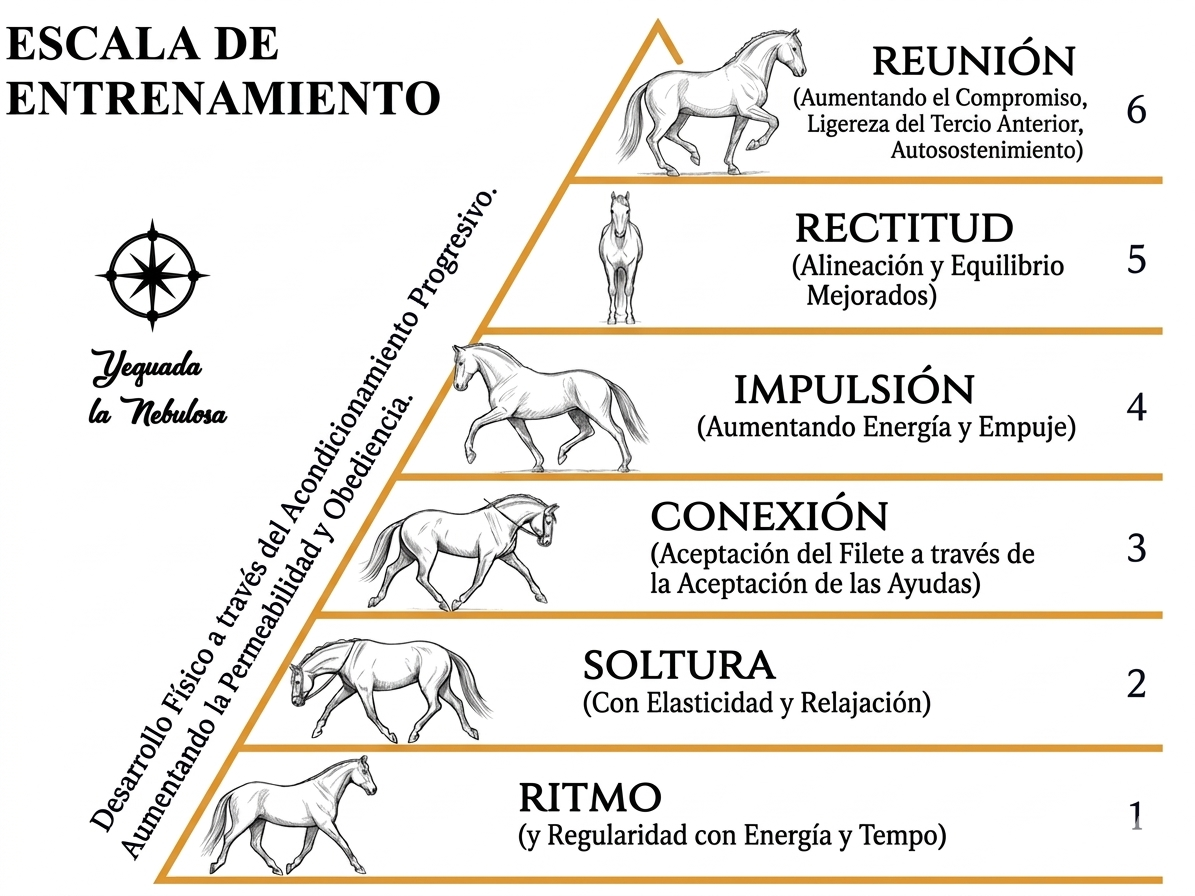
Beyond words, we invite you to see the results. In this link you will find our horses, whose development strictly follows the Training Scale. At Yeguada La Nebulosa, we believe that a horse is not ‘tamed’ until it has the right foundation. That is why, before offering a horse for sale, we make sure that it has consolidated its Rhythm, suppleness and Contact, and initiated its Impulsion and Straightness. This ensures that you acquire a horse with a healthy and functional back, designed for longevity and for both of you to enjoy a harmonious and stress-free riding experience.